Webequie Supply Road Project
Potential conditions established under section 64 of the Impact Assessment Act
Document reference number: 276
The Impact Assessment Agency of Canada is contemplating the following potential conditions in relation to the Webequie Supply Road Project (the Designated Project) located in Ontario for recommendation to the Minister of Environment (the Minister) for inclusion in a Decision Statement issued under the Impact Assessment Act. If the Designated Project is allowed to proceed, any condition established by the Minister in the Decision Statement issued under the Impact Assessment Act would become legally binding. The Designated Project would be allowed to proceed if: the Minister decides that the adverse effects within federal jurisdiction — and the adverse direct or incidental effects — of the Designated Project are, in light of the factors referred to in section 63 of the Impact Assessment Act and the extent to which these effects are significant, in the public interest; or if the Minister refers the matter of whether these effects are in the public interest to the Governor in Council, and the Governor in Council determines that these effects are, in light of the factors referred to in section 63 and the extent to which these effects are significant, in the public interest.
If a Decision Statement for the Designated Project is issued by the Minister, any condition established by the Minister in the Decision Statement issued under the Impact Assessment Act would become legally binding on Webequie First Nation (the Proponent) and the Proponent would be required to substantially begin (definition 1.30) to carry out the Designated Project within 5 years after the day the Minister issues the Decision Statement, or within any extension of that period established by the Minister in accordance with subsection 70(2) of the Impact Assessment Act. If the Proponent does not substantially begin to carry out the Designated Project by the end of that period, the Decision Statement will expire.
1 Definitions
1.1 Adverse federal effects means "adverse effects within federal jurisdiction" and "direct or incidental adverse effects" as defined in section 2 of the Impact Assessment Act.
1.2 Agency means the Impact Assessment Agency of Canada.
1.3 Baseline means the environmental, health, social and economic conditions prior to initiating construction of the Designated Project.
1.4 Construction means the phase of the Designated Project during which the Proponent undertakes the site preparation, building or installation of any components of the Designated Project, including periods during which these activities may temporarily cease.
1.5 Days means calendar days.
1.6 Designated Project means the Webequie Supply Road Project described in Schedule 1 of this document.
1.7 Environment and Climate Change Canada means the Department of the Environment as established under subsection 2(1) of the Department of the Environment Act.
1.8 Fish means "fish" as defined in subsection 2(1) of the Fisheries Act.
1.9 Fish habitat means "fish habitat" as defined in subsection 2(1) of the Fisheries Act.
1.10 Fisheries and Oceans Canada means the Department of Fisheries and Oceans as established under subsection 2(1) of the Department of Fisheries and Oceans Act.
1.11 Follow-up program means "follow-up program" as defined in section 2 of the Impact Assessment Act.
1.12 Heritage value means the aesthetic, historic, scientific, cultural, social or spiritual importance or significance for past, present or future generations.
1.13 Impact assessment means "impact assessment" as defined in section 2 of the Impact Assessment Act.
1.14 Indigenous groups means the following Indigenous peoples: Aroland First Nation, Attawapiskat First Nation, Eabametoong First Nation, Fort Albany First Nation, Kasabonika Lake First Nation, Kashechewan First Nation, Marten Falls First Nation, Neskantaga First Nation, Nibinamik First Nation, Webequie First Nation, Weenusk First Nation.
1.15 Indigenous peoples means "Indigenous peoples of Canada" as defined in section 2 of the Impact Assessment Act.
1.16 Local Study Area means the area that extends 1 kilometre from the centreline of the Designated Project route.
1.17 Migratory bird means "migratory bird" as defined in subsection 2(1) of the Migratory Birds Convention Act, 1994.
1.18 Mitigation measures means "mitigation measures" as defined in section 2 of the Impact Assessment Act.
1.19 Monitoring means collecting, analyzing, and using information to measure the adverse federal effects of the Designated Project and/or to verify the accuracy of the impact assessment and/or to determine the effectiveness of any mitigation measure.
1.20 Operation means the phase of the Designated Project during which public access to the Designated Project is allowed, including periods during which public access to the Designated Project may be temporarily interrupted.
1.21 Participate means to directly or indirectly assist or support initiatives through the provision of resources, including knowledge, time, data, access and other means that are economically and technically feasible and within the care and control of the Proponent.
1.22 Progressive reclamation means reclamation which is carried out by the Proponent concurrently with all phases of the Designated Project to progressively return any physically disturbed areas to a state as close to the baseline as possible, as soon after the disturbance as feasible.
1.23 Proponent means Webequie First Nation and its successors or assigns.
1.24 Qualified Individual means someone who, through education, experience and knowledge relevant to a particular matter, provides the Proponent with advice within their area of expertise. Knowledge relevant to a particular matter may include community and Indigenous knowledge.
1.25 Record means "record" as defined in section 2 of the Impact Assessment Act.
1.26 Relevant authority means federal, provincial and/or municipal authorities that are in possession of specialist or expert information or knowledge, or that have a responsibility for the administration of a law or regulation, with respect to the subject matter of a condition set out in this document.
1.27 Reporting year means January 1 to December 31 of the same calendar year.
1.28 Structure, site or thing of historical, archeological, paleontological or architectural significance means a structure, site or thing that is determined by a qualified individual, on the basis of heritage value, to be associated with an aspect of the history or culture of the people of Canada, including Indigenous peoples.
1.29 Substantially begin means initiating the following components and activities required to carry out the Designated Project:
- 1.29.1 construction of a worker camp;
- 1.29.2 construction of a temporary water crossing required to support the road construction;
- 1.29.3 establishment of one or more quarry or pit sites; and
- 1.29.4 site preparation, including clearing and earthwork, for the preferred route corridor.
1.30 Wetland means land that is saturated with water long enough to promote wetland or aquatic processes as indicated by poorly drained soils, hydrophytic vegetation and various kinds of biological activity which are adapted to a wet environment and as further defined in the Canadian Wetland Classification System.
Potential conditions
These conditions may be established for the sole purpose of the Decision Statement issued under the Impact Assessment Act. They do not relieve the Proponent from any obligation to comply with other legislative or other legal requirements of the federal, provincial, or local governments. Nothing in this document shall be construed as affecting what may be required of the Proponent to comply with all applicable legislative or legal requirements. In this document, a reference to a statute will include every amendment to it, every regulation made under it, every amendment made to a regulation made under it and any law enacted in substitution for, or in replacement of, it.
2 General conditions
2.1 The Proponent shall ensure that its actions in meeting the conditions set out in this document during all phases of the Designated Project are considered in a careful and precautionary manner, are informed by the best information and knowledge available at the time the Proponent takes action, including the most recent version of policies, guidelines and directives and community and Indigenous knowledge, are based on methods and models that are recognized by standard-setting bodies, are undertaken by qualified individuals, and have applied the best available economically or technically feasible technologies, or both.
Consultation
2.2 The Proponent shall, where consultation is a requirement of a condition set out in this document:
2.2.1 provide a written notice of the opportunity for the parties being consulted to present their views and information on the subject matter of the consultation;
2.2.2 provide all available information that is relevant to the scope and the subject matter of the consultation and a reasonable period of time not less than 30 days, or as otherwise agreed upon with the parties being consulted, to prepare their views and information;
2.2.3 undertake an impartial consideration of all views and information presented by the parties being consulted on the subject matter of the consultation; and
2.2.4 advise as soon as feasible in writing the parties being consulted on how the views and information received have, or have not, been integrated into the subject matter of the consultation by the Proponent and provide a justification.
2.3 The Proponent shall, where consultation with Indigenous groups is a requirement of a condition set out in this document, communicate with each Indigenous group with respect to the manner to satisfy the consultation requirements referred to in condition 2.2, including:
2.3.1 methods of notification;
2.3.2 the type of information and the period of time to be provided when seeking input;
2.3.3 the process to be used by the Proponent to undertake impartial consideration of all views and information presented on the subject of the consultation; and
2.3.4 the period of time and the means to advise Indigenous groups of how their views and information were considered by the Proponent.
Follow-up requirements
2.4 The Proponent shall, where a follow-up program is a requirement of a condition set out in this document, develop the follow-up program taking into account any guidance documents provided by the Agency and determine, as part of the development of each follow-up program and in consultation with the parties being consulted during the development, the following information, unless already specified in the condition:
2.4.1 a description of the effects predictions or mitigation measures or both that will be evaluated through the follow-up program as required in the particular follow-up program condition;
2.4.2 the methodology, location, frequency, timing and duration of monitoring associated with the follow-up program;
2.4.3 the scope, content and frequency of reporting of the results of the follow-up program to the parties consulted for the development of the follow-up program;
2.4.4 the minimum frequency at which the follow-up program must be reviewed and, if necessary, updated;
2.4.5 the levels of environmental, health, social or economic changes relative to baseline that would require the Proponent to implement modified or additional mitigation measures, including instances where the Proponent may require Designated Project activities causing the change to be stopped;
2.4.6 the technically and economically feasible mitigation measures to be implemented by the Proponent if monitoring conducted as part of the follow-up program shows that the levels of change referred to in condition 2.4.5 have been reached or exceeded in order to return changes to levels below those referred to in condition 2.4.5;
2.4.7 the specific quantifiable end points that must be achieved before the follow-up program can end. Those end points should indicate that the accuracy of the impact assessment has been verified or that the mitigation measures are effective or both; and
2.4.8 the details of the results of the follow-up program to report to the Agency pursuant to condition 2.7.5.
2.5 The Proponent shall update the details determined for each follow-up program pursuant to condition 2.4 during the implementation of each follow-up program, at the minimum frequency determined pursuant to condition 2.4.4 and in consultation with the parties being consulted during the development of each follow-up program.
2.6 The Proponent shall provide the details of the follow-up programs referred to in conditions 3.1, 6.7 and 6.8, including the information determined for each follow-up program pursuant to condition 2.4, to the Agency and to the parties being consulted during the development of each follow-up program prior to the implementation of each follow-up program. The Proponent shall also provide any update made pursuant to condition 2.5 to the Agency and to the parties being consulted during the development of each follow-up program within 30 days of the follow-up program being updated.
2.7 The Proponent shall, where a follow-up program is a requirement of a condition set out in this document:
2.7.1 implement the follow-up program according to the information determined pursuant to condition 2.4 and any requirement specified in conditions specific to each follow-up program;
2.7.2 conduct monitoring and analysis to verify the accuracy of the impact assessment predictions as it pertains to the particular condition or to determine the effectiveness of any mitigation measure or both;
2.7.3 determine whether modified or additional mitigation measure(s) are required based on the monitoring and analysis undertaken pursuant to condition 2.7.2;
2.7.4 if modified or additional mitigation measure(s) are required pursuant to condition 2.7.3, develop and implement these mitigation measure(s) as soon as feasible and monitor them pursuant to condition 2.7.2. The Proponent shall notify the Agency in writing within 24 hours of any modified or additional mitigation measure being implemented. If the Proponent implements any additional or modified mitigation measure not previously submitted to the Agency pursuant to condition 2.4.6, the Proponent shall submit a detailed description of the measure(s) to the Agency within 7 days of their implementation; and
2.7.5 report all results of the follow-up program to the Agency no later than 3 months following each reporting year during which the follow-up program is implemented and, subject to information determined pursuant to condition 2.4.3, to the parties being consulted during the development of the follow-up program. As part of reporting the results of the follow-up program, the Proponent shall, for each follow-up program, provide an analysis and conclusion about the accuracy of the effects predictions made during the impact assessment and effectiveness of mitigation measures.
2.8 Where consultation with Indigenous groups is a requirement of a follow-up program, the Proponent shall discuss the follow-up program with each group and shall determine, in consultation with each group, opportunities for their participation and resources required to support their participation in the implementation of the follow-up program, including the conduct of monitoring, the analysis and reporting of follow-up results and whether modified or additional mitigation measure(s) are required, as set out in condition 2.7.
Annual reporting
2.9 The Proponent shall prepare an annual report for each reporting year that sets out:
2.9.1 the activities undertaken by the Proponent to comply with each of the conditions set out in this document;
2.9.2 how the Proponent complied with condition 2.1;
2.9.3 for conditions set out in this document for which consultation is a requirement, how the Proponent considered any views and information that the Proponent received during or as a result of the consultation, including and Indigenous knowledge;
2.9.4 the information referred to in conditions 2.4 for each follow-up program and any update to that information made pursuant to condition 2.5;
2.9.5 a summary of the information reported pursuant to condition 2.7.5 for each follow-up program;
2.9.6 for any condition where implementation is stated to be dependent in whole or in part upon technical and/or economic feasibility, and the Proponent has determined it is not technically and/or economically feasible, a justification for that determination;
2.9.7 for any plan that is a requirement of a condition set out in this document, any update(s) to the plan that have been made during the reporting year; and
2.9.8 any modified or additional mitigation measure implemented or proposed to be implemented by the Proponent, as determined pursuant to condition 2.7.
2.10 The Proponent shall submit the annual report referred to in condition 2.9 to the Agency, including a plain language executive summary in both official languages, no later than 3 months following the reporting year to which the annual report applies.
2.11 The first reporting year for which the Proponent shall prepare an annual report pursuant to condition 2.10 shall start on the day the Minister issues the Decision Statement pursuant to subsection 65 (1) of the Impact Assessment Act.
Information sharing
2.12 The Proponent shall publish on the Internet, or any medium which is publicly available, the annual reports and the executive summaries referred to in conditions 2.9 and 2.10, the accidents and malfunctions response plans referred to in condition 9.1, the schedules referred to in conditions 2.18 and 2.19, and any update or revision to the above documents, upon submission of these documents to the parties consulted for the respective conditions. The Proponent shall keep these documents publicly available for 25 years following their publication. The Proponent shall notify the Agency and Indigenous groups of the availability of these documents within 3 business days of their publication.
2.13 When the development of any plan is a requirement of a condition set out in this document, the Proponent shall submit the plan to the Agency prior to implementation, unless otherwise required through the condition.
Change of Proponent
2.14 The Proponent shall notify the Agency and Indigenous groups in writing no later than 30 days after the day on which there is any transfer of ownership, care, control or management of the Designated Project in whole or in part.
2.15 The Proponent shall notify the Agency in writing of any change to the contact information of the Proponent within 30 days of the change in contact information.
Change to the Designated Project
2.16 If the Proponent is proposing to carry out the Designated Project in a manner other than described in Schedule 1 of this document, the Proponent shall notify the Agency in writing in advance of carrying out the proposed activities. As part of the notification, the Proponent shall provide:
2.16.1 a description of the proposed change(s) to the Designated Project and the adverse federal effects that may result from the proposed change(s);
2.16.2 any modified or additional measure to mitigate any adverse federal effects that may result from the proposed change(s) and any modified or additional follow-up requirement;
2.16.3 an explanation of how, taking into account any modified or additional mitigation measure referred to in condition 2.16.2, the federal adverse effects that may result from the proposed change(s) may differ from the federal effects of the Designated Project identified during the impact assessment; and
2.16.4 the results of consultation with Indigenous groups on the proposed changes, if the proposed changes may adversely affect those Indigenous groups, if the proposed changes may adversely affect those Indigenous groups, including any views on the adverse federal effects referred to in condition 2.16.1 and on the modified or additional mitigation measures and follow-up requirements referred to in condition 2.16.2.
2.17 The Proponent shall provide to the Agency any additional information required by the Agency about the proposed change(s) referred to in condition 2.16, which may include the results of consultation with relevant authorities on the proposed change(s) and federal effects referred to in condition 2.16.1 and the modified or additional mitigation measures and follow-up requirements referred to in condition 2.16.2.
Schedules
2.18 The Proponent shall submit to Indigenous groups, the Agency and any other relevant authorities, and no later than 30 days prior to the start of construction, a schedule outlining all activities planned to fulfill each condition set out in this document, including consultation activities pursuant to condition 2.2. The schedule shall indicate the commencement and estimated completion month(s) and year(s) for each of these activities.
2.19 The Proponent shall submit to Indigenous groups, the Agency and any other relevant authorities, and no later than 30 days prior to the start of construction, a schedule outlining all activities required to carry out all phases of the Designated Project. The schedule shall indicate the commencement and estimated completion month(s) and year(s) and duration of each of these activities.
2.20 The Proponent shall submit to Indigenous groups, the Agency and any other relevant authorities in writing an annual update to schedules referred to in conditions 2.18 and 2.19 every year no later than 3 months following each reporting year, until completion of all activities referred to in each schedule.
Record keeping
2.21 The Proponent shall maintain all records relevant to the implementation of the conditions set out in this document. The Proponent shall retain the records and make them available to the Agency throughout construction and operation and for 25 years following their publication. The Proponent shall provide the aforementioned records to the Agency upon demand within a timeframe specified by the Agency.
2.22 The Proponent shall retain all records referred to in condition 2.21 at a facility in Canada, and shall provide the address of the facility to the Agency. The Proponent shall notify the Agency at least 30 days prior to any change to the physical location of the facility where the records are retained, and shall provide the address of the new location to the Agency.
3 Fish and fish habitat
3.1 The Proponent shall develop, prior to in-water work or ground disturbing work and implement, during all phases of the Designated Project, a follow-up program to verify the accuracy of the impact assessment and determine the effectiveness of mitigation measures with respect to effects from the Designated Project on fish and fish habitat resulting from changes to water quality. The Proponent shall develop the follow-up program in consultation with Webequie First Nation with respect to waterbodies located on the Webequie First Nation reserve, and in consultation with Indigenous groups, Fisheries and Oceans Canada, Environment and Climate Change Canada and the Ontario Ministry of Natural Resources with respect to waterbodies located on provincial lands within the Local Study Area. As part of the follow-up program, the Proponent shall:
3.1.1 monitor, beginning during construction and continuing until a three-year trend analysis during operation indicates that water quality will not change due to effects attributed to the Designated Project, water quality parameters in groundwater and surface water, including total suspended solids, acidity, electrical conductivity, sulphates, nitrates, and heavy metals and metalloids, including aluminum, mercury, arsenic, copper, iron, lead, manganese, nickel, and zinc, in waters frequented by fish;
3.1.2 compare the monitoring results in condition 3.1.1 to the Canadian Council of Ministers of the Environment's Canadian Water Quality Guidelines for the Protection of Aquatic Life. If monitoring results indicate an increase in adverse effects to fish and fish habitat as a result of changes to water quality, implement modified or additional measures; and
3.1.3 provide opportunities for Indigenous groups to participate in monitoring activities and make the monitoring results available to Indigenous groups.
4 Migratory birds
4.1 The Proponent shall carry out the Designated Project in a manner that protects migratory birds and avoids capturing, killing, taking, injuring or harassing migratory birds or destroying, taking or disturbing their eggs, or damaging, destroying, removing or disturbing nests protected under the Migratory Birds Convention Act, 1994 and its regulations or the Species at Risk Act or both, while taking into account Environment and Climate Change Canada's Guidelines to Avoid Harm to Migratory Birds.
4.2 The Proponent shall determine, under the direction of a qualified individual, the presence or likely presence of migratory bird nest(s) protected under the Migratory Birds Convention Act, 1994 and its regulations, and residences protected under the Species at Risk Act that may be adversely affected by any Designated Project activity prior to initiating the activity. The Proponent shall use non-intrusive methods to determine the presence or likely presence of migratory bird nests.
4.3 The Proponent shall not undertake any activity associated with the Designated Project that could harm the nesting of birds other than migratory birds and that are species at risk on the Webequie First Nation Reserve, to avoid the destruction of nests, eggs or nestlings. In doing so, the Proponent shall:
4.3.1 determine, under the direction of a qualified individual, the dates of relevant nesting periods for bird species other than migratory birds for any year during which these activities are carried out. The Proponent shall inform the Agency of these dates, including a justification, before carrying out these activities;
4.3.2 not undertake or continue any activity likely to harm nesting within the nesting periods determined under condition 4.3.1, unless this is not technically or economically feasible; and
4.3.3 provide a justification to the Agency if it is not technically feasible to carry out any activity that could harm nesting outside the nesting periods determined in accordance with condition 4.3.1, and develop and implement additional mitigation measures to avoid adverse effects on birds during nesting. The Proponent shall provide these measures to the Agency before implementing them.
4.4 The Proponent shall establish and delineate, under the direction of a qualified individual, setback distances around the nest(s) and residence(s) whose presence or likely presence is determined pursuant to condition 4.2 within which that activity shall not occur while those nests are protected under the Migratory Birds Convention Act, 1994 and its regulations or the Species at Risk Act, or both. When establishing setback distances, the Proponent shall take into account Environment and Climate Change Canada's Guidelines to Avoid Harm to Migratory Birds.
4.5 The Proponent shall develop, prior to construction and in consultation with Indigenous groups and relevant authorities, and implement during all phases of the Designated Project, measures to prevent bank swallow (Riparia riparia) from nesting in pits and quarries, taking into account Environment and Climate Change Canada's document Bank Swallow (Riparia riparia): in sandpits and quarries.
5 Health and socio-economic conditions of Indigenous peoples
5.1 The Proponent shall develop and implement, within four months of the start of construction, a Community Readiness Plan to mitigate adverse effects on the social conditions of Indigenous peoples. As part of the implementation of the Community Readiness Plan, the Proponent shall make available, during construction, on-duty community liaison officers for community members to contact for conflict resolution.
5.2 The Proponent shall develop, within four months of the start of construction, and in consultation with Indigenous groups and relevant authorities, and implement, during all phases of the Designated Project, measures to promote safe, respectful and inclusive conduct in the workplace and community to mitigate adverse effects on the health and social conditions of Indigenous peoples. In doing so, the Proponent shall:
5.2.1 implement a workplace anti-harassment, anti-bullying, anti-discrimination and anti-violence policy that incorporates gender-appropriate, gender-specific, and culturally appropriate policies and processes, including sexual harassment and assault counselling as well as confidential and culturally sensitive care;
5.2.2 implement a workplace policy on the use and possession of drugs and alcohol, which prohibits the use of, or being under the influence of, illicit drugs or alcohol during work hours;
5.2.3 establish a worker code of conduct that outlines expectations and requirements in relation to the measures developed to promote safe, respectful and inclusive conduct in the workplace and the community while incorporating the policies and training referred to in conditions 5.2.1, 5.2.2 and 5.2.3; and
5.2.4 implement a fair and timely process to investigate and resolve incidents and complaints from Designated Project employees.
6 Current use of lands and resources for traditional purposes
6.1 The Proponent shall establish, prior to construction, and implement, during construction, a process for receiving and addressing complaints related to the effects of Designated Project activities on noise, dust, air quality and water quality. As part of the process, the Proponent shall:
6.1.1 address complaints within 24 hours of receipt; and
6.1.2 implement corrective measures, as applicable, to reduce exposure in a timely manner. The Proponent shall inform Indigenous groups of these corrective measures.
6.2 The Proponent shall mitigate adverse effects on the current use of resources for traditional purposes from sensory disturbance related to the Designated Project. In doing so, the Proponent shall:
6.2.1 restrict project activities during periods of dry and high-wind conditions;
6.2.2 schedule, in consultation with Indigenous groups, project activities expected to reduce air quality and elevate noise levels; and
6.2.3 notify Indigenous groups of the timing when and locations where reduced air quality and elevated noise levels are expected to occur to avoid or minimize exposure.
6.3 The Proponent shall conduct progressive reclamation of areas disturbed by the Designated Project. In doing so, the Proponent shall:
6.3.1 identify, in consultation with Indigenous groups, plant species for use in establishing self-sustaining vegetation communities; and
6.3.2 conduct vegetation clearing outside sensitive breeding periods, including winter months, for wildlife of importance to Indigenous groups.
6.4 The Proponent shall establish and delineate, under the direction of qualified individuals, setbacks and buffer zones around wetlands, riparian habitats, and known wildlife features and seasonal habitats, including nursing areas, for wildlife of importance to Indigenous groups.
6.5 The Proponent shall provide, prior to construction, opportunities for:
6.5.1 Webequie First Nation to harvest plants on the Webequie First Nation reserve; and
6.5.2 all other Indigenous groups to harvest plants on provincial lands.
6.6 The Proponent shall train Designated Project employees and contractors on wildlife awareness to mitigate adverse effects from the Designated Project on wildlife of importance to Indigenous groups.
6.7 The Proponent shall develop prior to construction and implement during construction and during maintenance activities in relation to aggregate quarrying during operation a follow-up program to mitigate effects from sensory disturbance attributed to the Designated Project on the current use of lands and resources for traditional purposes. In doing so, the Proponent shall:
6.7.1 monitor, at various locations on the Webequie First Nation reserve:
6.7.1.1 air quality contaminants including levels of dust, PM10, PM2.5, diesel particulate matter, sulphur dioxide, nitrogen dioxide, acrolein, benzene, benzo(a)pyrene, hexavalent chromium, iron, and nickel; and
6.7.1.2 noise levels;
6.7.2 implement additional or modified mitigation measures if monitoring shows an increase in air quality contaminants or noise levels based on relevant indicators and thresholds; and
6.7.3 notify Indigenous groups of any increases pursuant to condition 6.8.2 and include with the notification the monitoring results pursuant to condition 6.8.1.
6.8 The Proponent shall develop, prior to construction, and in consultation with Indigenous groups and Environment and Climate Change Canada, and implement during all phases of the Designated Project, a follow-up program to verify the accuracy of the impact assessment and determine the effectiveness of mitigation measures with respect to adverse effects from the Designated Project on the current use of lands and resources for traditional purposes related to wildlife of importance to Indigenous groups. As part of the follow-up program, the Proponent shall:
6.8.1 monitor adverse effects to the population, habitat and predator/prey dynamics of wildlife of importance to Indigenous groups; and
6.8.2 provide the monitoring results to Indigenous groups.
7 Physical and cultural heritage of, and structures, sites or things of historical, archaeological, paleontological or architectural significance to, Indigenous peoples
7.1 The Proponent shall inform Designated Project employees and contractors of the locations of potential archaeological resources and designate those locations as no-work zones to mitigate adverse effects on structures, sites or things of historical, archaeological, or paleontological significance.
7.2 The Proponent shall, prior to construction, offer opportunities to Indigenous groups for spiritual monitors trained by Elders to provide advice on areas to be avoided during construction to mitigate adverse effects on structures, sites or things of historical, archaeological, or paleontological significance. The Proponent shall, where possible, designate these areas as no-work zones. If not possible, the Proponent shall provide the reasons to the Agency and Indigenous groups.
7.3 The Proponent shall develop prior to construction and implement during construction, a chance-find protocol to mitigate adverse effects on structures, sites or things of historical, archaeological, or paleontological significance for any previously unidentified structures, sites or things of historical, archaeological, paleontological or architectural significance discovered within the Local Study Area. As part of the chance-find protocol, the Proponent shall:
7.3.1 immediately halt work at the location of a discovery;
7.3.2 delineate an area around a discovery as a no-work zone;
7.3.3 notify Indigenous groups and the Agency within 24 hours of a discovery and allow Indigenous groups to monitor archaeological works; and
7.3.4 develop mandatory training on chance finds, which includes the identification of sensitive locations and the implementation of conditions 7.3.1, 7.3.2 and 7.3.3, and deliver this training to all employees and contractors associated with the Designated Project.
8 Species at risk
8.1 The Proponent shall conduct, in consultation with Environment and Climate Change Canada and relevant authorities, work during construction including blasting and maintenance work during operation on the Webequie First Nation reserve outside of the period of May 1 to August 31 when feasible to mitigate adverse effects to little brown myotis (Myotis lucifugus) and northern myotis (Myotis septentrionalis).
8.2 The Proponent shall establish and delineate, during construction and maintenance activities during operation and under the direction of a qualified individual, a vegetation setback of 120 metres from any maternity roosting habitats of little brown myotis (Myotis lucifugus) or northern myotis (Myotis septentrionalis) on the Webequie First Nation Reserve.
8.3 The Proponent shall ensure Designated Project employees and contractors are trained to identify maternity roosting habitat of little brown myotis (Myotis lucifugus) and northern myotis (Myotis septentrionalis) on the Webequie First Nation reserve and are aware of protocols to follow should any be found including:
8.3.1 immediately halt work at the location of a discovery;
8.3.2 delineate an area around a discovery as a no-work zone;
8.3.3 notify, as soon as feasible, Indigenous groups, Environment and Climate Change Canada and the Agency of the discovery; and
8.3.4 maintain the no-work zone around identified maternity roosting habitat.
9 Accidents and malfunctions
9.1 The Proponent shall develop, prior to construction and in consultation with Indigenous groups and relevant authorities, and implement, during construction, an accidents and malfunctions response plan in relation to the Designated Project. The accidents and malfunctions response plan shall include:
9.1.1 a description of the potential types of accidents and malfunctions that may cause adverse federal effects, including severe structural failure, major spill, fire, explosion and extreme weather events;
9.1.2 the measures to be implemented in response to each type of accident and malfunction referred to in condition 9.1.1 to mitigate any adverse federal effect caused by the accident or malfunction taking into account Environment and Climate Change Canada's Guidelines for Effective Wildlife Response Plans; and
9.1.3 for each type of accident and malfunction referred to in condition 9.1.1, the roles and responsibilities of those involved in the implementation of the measures referred to in condition 9.1.2, including the Proponent, each relevant authority, and any other party that may be called upon to respond to an accident or malfunction.
9.2 The Proponent shall maintain the accidents and malfunctions response plans referred to in condition 9.1 up to date during construction. The Proponent shall submit any updated accidents and malfunctions response plan to the Agency and to parties consulted for the development of the plan within 30 days of the plan being updated.
9.3 In the event of an accident or malfunction with the potential to cause adverse federal effects during construction, including an accident or a malfunction referred to in condition 9.1.1, the Proponent shall immediately implement the measures appropriate to remedy the accident or malfunction, including any measure referred to in condition 9.1.2, and shall:
9.3.1 notify, as soon as feasible, relevant authorities with responsibilities related to emergency response, including environmental emergencies, in accordance with applicable legislative and regulatory requirements;
9.3.2 notify, as soon as feasible, Indigenous groups of the accident or malfunction and notify the Agency in writing no later than 48 hours following the accident or malfunction. In doing so, the Proponent shall specify:
9.3.2.1 the date and time when and location where the accident or malfunction occurred;
9.3.2.2 a summary description of the accident or malfunction;
9.3.2.3 a list of any substance and estimated quantities potentially released into the environment as a result of the accident or malfunction; and
9.3.2.4 a list of the relevant authorities notified pursuant to condition 9.1.3 and of the relevant authorities engaged in response to the accident or malfunction;
9.3.3 submit a written report to the Agency no later than 60 days after the day on which the accident or malfunction occurred. The written report shall include:
9.3.3.1 a detailed description of the accident or malfunction and of its adverse federal effects;
9.3.3.2 a description of the measures that were taken by the Proponent to mitigate the adverse federal effects caused by the accident or malfunction;
9.3.3.3 any view from Indigenous groups and advice from relevant authorities received with respect to the accident or malfunction, its adverse federal effects and the measures taken by the Proponent to mitigate these adverse federal effects;
9.3.3.4 a description of any residual adverse federal effects and any modified or additional measure required by the Proponent to mitigate residual adverse federal effects;
9.3.3.5 a description of the changes made to avoid a subsequent occurrence of the accident or malfunction; and
9.3.3.6 details concerning the implementation of the accidents and malfunctions response plan referred to in condition 9.1.
Description of the Designated Project
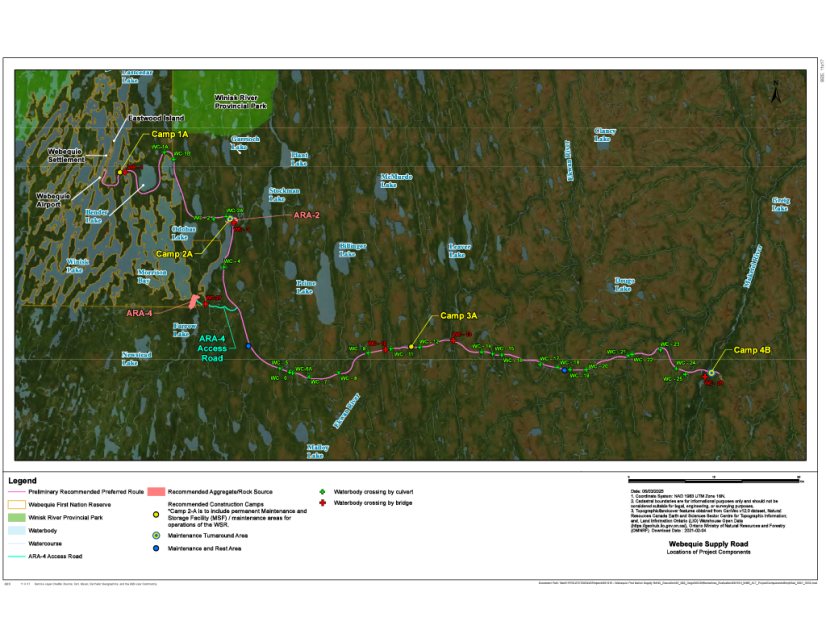
The Designated Project is the construction and operation of an all-season road on provincial Crown land and Webequie First Nation Reserve land in northwestern Ontario. The Designated Project is a 2-lane gravel public highway of approximately 107 kilometres (km) connecting the Webequie First Nation and its airport to the McFaulds Lake area (Figure 1).
The Designated Project includes the following physical activities and components.
Physical activities
- Construction
- Field surveys, staking and layout;
- Vegetation clearing and grubbing;
- Earth excavation, grading and hauling;
- Construction of project components; and
- Reclamation of temporary infrastructure.
- Operation (indefinite)
- Road maintenance including maintenance of the access road and drainage system;
- Operation of pits and quarries in two aggregate source areas; and
- Dust control.
Project components
- Approximately 107 km of two-lane gravel road approximately 13 metre (m) wide within a fully cleared right of way of approximately 35 m;
- Water crossings including bridges and culverts;
- Maintenance and storage facility including a permanent access road;
- Quarries, pits and associated infrastructure;
- Temporary construction camps with storage and laydown yards and associated infrastructure including sanitary and solid waste storage;
- Temporary rest and maintenance areas; and
- Temporary access roads to quarries, pits, laydown areas, and construction camps.